Tier 01
Individual
"What can I do, what should I learn next, and where could I go?" A personal mirror, coach and navigator — capability growth that belongs to the person, not just the org chart.
How it works
One pipeline ingests the work you need done and returns an evidence-cited plan to build the capability to do it — gap-analysed against the people you already have.

The flow
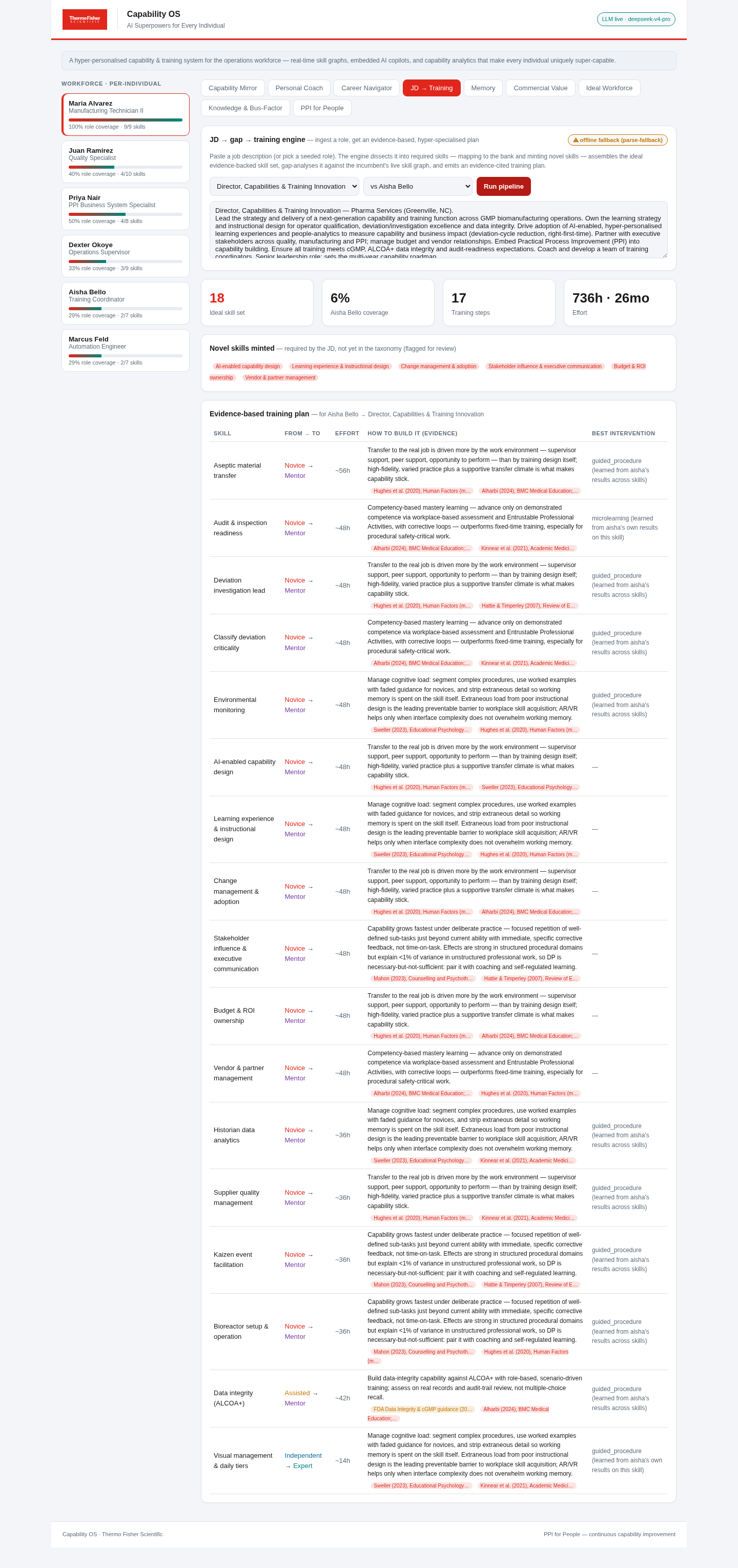
Paste a real JD — or pick a seeded one. SMART treats it as the definition of the work that needs doing, not a static document to file away.
The JD is broken into the skills it actually requires, mapped onto the ontology. Where the work needs a capability the taxonomy doesn't yet cover, SMART mints the novel skill rather than dropping it.
Each required skill is attached to its graded evidence pack — what actually builds that capability best — producing the target a strong performer in the role would meet.
The ideal set is compared to an incumbent's live skill graph. Gaps are value-weighted so the most consequential shortfalls lead, and coverage is expressed as a single honest percentage.
The output is a prerequisite-ordered, evidence-cited plan with the best-known intervention per step — then delivered and measured through the copilots, with the skill graph updating as learning completes.
Who it's for
The same capability graph serves four different questions — so an individual's growth and an organisation's strategy are reading from the same data, not two disconnected systems.
Tier 01
"What can I do, what should I learn next, and where could I go?" A personal mirror, coach and navigator — capability growth that belongs to the person, not just the org chart.
Tier 02
"Who on my team can do this work, and where are our gaps?" Team coverage, task-to-best-person allocation, and the next-best training action per report.
Tier 03
"Is my function fit for what's coming?" Ideal-workforce design, projected gap analysis, and capability tied to the profit levers the function owns.
Tier 04
"Where is knowledge at risk and is our training working?" Bus-factor and retention, intervention effectiveness over time, and capability analytics across the whole workforce.
The engine
The scheduling maths — gap detection, prerequisite-respecting ordering, skill decay, coverage — is computed by a deterministic, testable engine. The AI is used for rationale and content: assessment narrative, coaching steps, microlearning, the career story. So "adaptive" is real, not a vibe.
SMART keeps a longitudinal record of each person's capability and — crucially — which interventions actually moved each skill, and by how much. Over time it learns the best-known intervention per learner, falling back from person to cohort when history is thin.
Copilots retrieve the governing SOP or evidence with vector embeddings (lexical fallback if no embedding endpoint is reachable) and answer with citations. With no model key configured, every copilot degrades to deterministic, engine-grounded content that is clearly labelled as an offline fallback — a faked response is never mistaken for a live one.